
Switching to solar energy isn’t just about going green—it’s about making a smart financial decision. With electricity bills rising every year, homeowners and businesses are now looking for reliable ways to measure how much they can actually save. That’s where a solar ROI calculator becomes essential.
This simple yet powerful tool helps you estimate the return on investment (ROI) of installing solar panels by comparing your upfront costs with long-term benefits like monthly bill reductions, yearly electricity savings, and lifetime payback value. Instead of guessing how much solar can cut your power expenses, a calculator gives you a clear picture with numbers, charts, and even payback period projections.
Whether you’re a homeowner tired of fluctuating utility bills or a business planning a large-scale solar project, understanding your solar ROI ensures you make a confident, informed decision. By analyzing your energy consumption, local electricity rates, and solar installation costs, you’ll know exactly how long it will take for your system to pay for itself—and how much profit you’ll enjoy afterward.
In short, a solar savings estimator bridges the gap between curiosity and action, turning the idea of “saving with solar” into a practical, measurable reality.
Solar ROI Calculator | Estimate Solar Panel Payback & Savings
Solar Savings Estimator
Step-by-Step Guide: How to Use the Solar Savings Calculator in Pakistan
If you’ve ever wondered, “How can I calculate my solar savings in Pakistan?”—this is where you’ll find the answer. Our Solar Savings Calculator is built to be simple, fast, and accurate. In just a few quick steps, you can estimate how much you’ll save on electricity and how soon your solar investment will pay for itself.
Here’s how it works:
1. Enter Your Monthly Electricity Usage (kWh)
Take a look at your latest electricity bill and note down the total units consumed. For example, if your bill shows 620 kWh, type that number into the calculator. This helps the tool understand your current power demand.
2. Add Your Solar Panel System Size (in kW)
Enter the capacity of the solar panel system you plan to install—like 3 kW, 5 kW, or 10 kW. The calculator uses this to estimate how much energy your photovoltaic (PV) system will generate each month.
3. Input the Current Electricity Tariff Rate
Check your bill for the PKR/kWh rate you’re currently paying. For instance, if it’s Rs. 45/kWh, the calculator will use this to calculate your cost savings accurately.
4. Include Net Metering Credit Values
If you have net metering enabled, enter the buy-back rate (PKR/kWh) your utility company offers for exported electricity. This ensures the savings results reflect your actual potential earnings from sending extra power back to the grid.
5. View Your Estimated Savings & Payback Period
Once you hit Calculate, you’ll instantly get a personalized report showing:
-
How much your monthly bill will reduce.
-
How much you’ll save in a year.
-
Your payback period—the time it takes for your system to pay for itself.
-
Your projected ROI (Return on Investment) over the solar panel’s lifespan.
Example:
If you consume 600 kWh/month, install a 5 kW solar system, and have net metering at Rs. 20/kWh, you could potentially reduce your electricity bill to zero—and even earn credits—saving thousands of rupees annually.
It’s fast, it’s accurate, and it’s the easiest way to see the financial impact of going solar in Pakistan.
What is a Solar ROI Calculator?
A Solar ROI Calculator is a smart tool designed to help you understand the financial benefits of installing a solar panel system. Instead of leaving you with rough estimates, it calculates how much money you’ll save on electricity over time, how quickly your system will pay for itself, and what your overall return on investment (ROI) looks like. Think of it as your personal guide to making solar a financial reality rather than just an environmental choice.
Often referred to as a solar savings estimator, this calculator factors in your electricity usage, local utility rates, and the cost of installing a photovoltaic (PV) system. It doesn’t just stop there—it also accounts for net metering policies, which allow you to earn credits by sending excess solar power back to the grid. These credits can significantly increase your overall savings and shorten your payback period.
Now, many people confuse a solar ROI calculator with a solar payback calculator. While both are useful, they serve slightly different purposes. A solar payback calculator focuses on the time it will take for your initial investment to be recovered through energy savings. On the other hand, a solar ROI calculator takes a broader view—it calculates not only your payback period but also your long-term financial returns, including lifetime profits and annual ROI percentages.
In simple terms, the solar ROI calculator gives you the “big picture.” It helps you understand not just when you’ll break even, but how much you’ll gain over the lifespan of your solar system.
How a Solar ROI Calculator Works
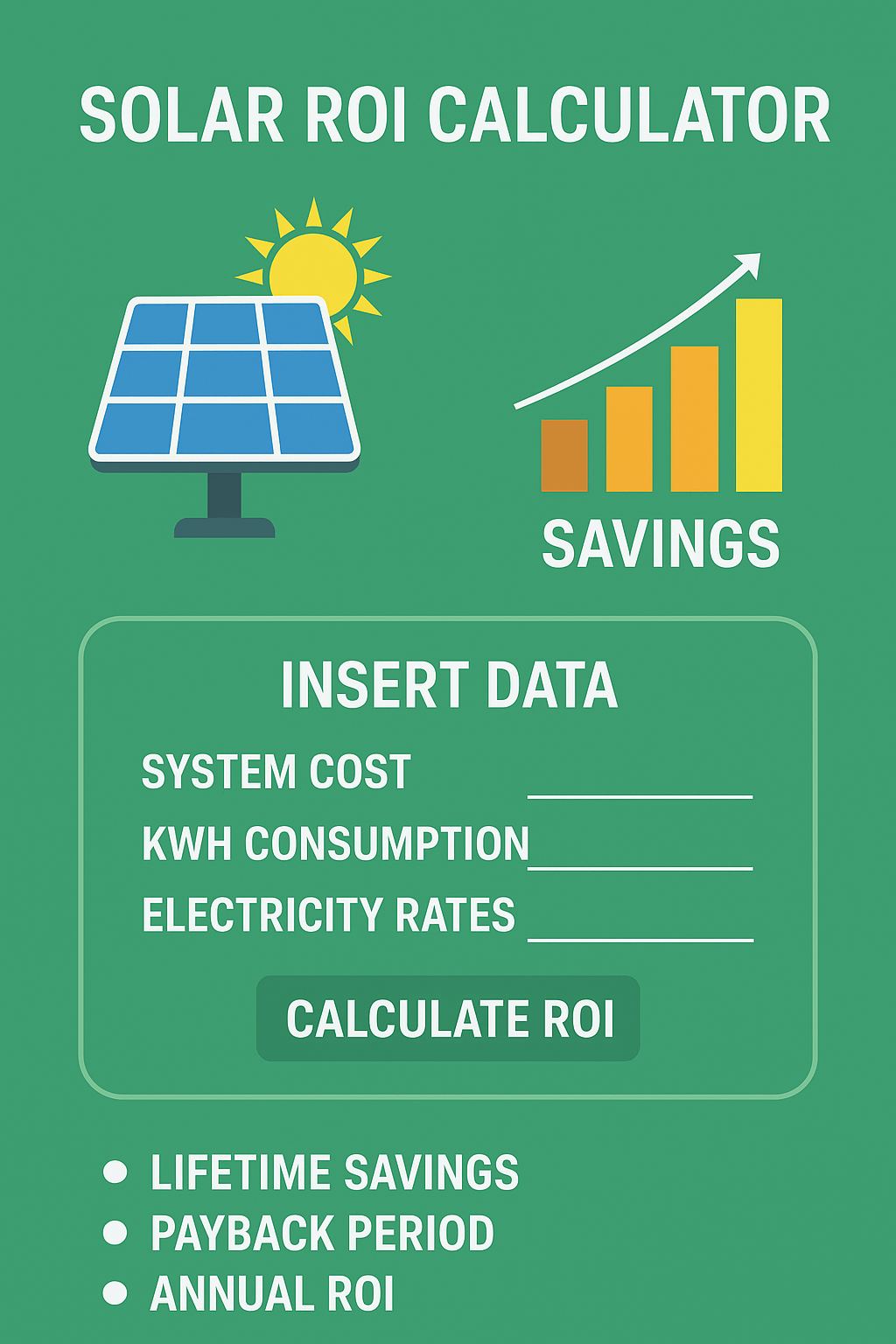
At first glance, the idea of calculating your solar return on investment might sound complex—but a solar ROI calculator makes it simple. By entering a few basic details about your electricity usage and installation costs, you can quickly see how much you’ll save and when your solar panels will start paying for themselves.
Here’s what goes into it:
Inputs You Provide
-
System Cost – The upfront price of installing your solar panel system.
-
Power Consumption (kWh) – The number of electricity units you use every month (taken from your bill).
-
Electricity Rates – The per-unit cost charged by your utility company, which continues to rise each year.
-
Government Solar Incentives or Net Metering Credits – Any rebates, subsidies, or buy-back rates that help reduce costs or add extra savings.
Outputs You Get
Once the data is entered, the calculator generates a personalized report showing:
-
Lifetime Savings – How much money you’ll save over 20–25 years of using solar.
-
Payback Period – How long it will take for your system to “break even” (also known as the solar breakeven analysis).
-
Annual ROI – The yearly percentage return you can expect on your solar investment.
Why It Matters
Instead of guessing whether solar is worth it, the calculator gives you real numbers backed by your actual consumption and costs. It allows you to calculate your solar panel payback period with accuracy, helping you see not just short-term bill reductions but also the long-term financial benefits of clean energy.
In short, a solar ROI calculator turns what seems like a complicated financial decision into a clear, easy-to-understand analysis—so you know exactly when your investment pays off and how much profit it brings in the years ahead.
Key Factors That Impact Your Solar ROI
Not every solar investment delivers the same level of savings. Your solar ROI depends on a mix of financial, technical, and policy factors that directly affect how quickly your system pays for itself. By understanding these key elements, you can make smarter decisions and maximize both your savings and your environmental benefits.
Installation Cost & Financing Options
The upfront installation cost of a solar panel system is the biggest factor in your ROI calculation. While prices have dropped significantly in Pakistan, the way you choose to finance your system also plays a role. Paying upfront usually shortens your payback period, while loans or installment plans may spread the cost over time but extend the break-even point.
Net Metering Policies & Government Solar Incentives
If your utility company offers net metering, you can sell excess electricity back to the grid and earn credits on your bill. This alone can dramatically improve your ROI. On top of that, government solar incentives and subsidies can lower your initial investment, making solar more affordable and boosting your lifetime savings.
Local Electricity Rates
Your current and future electricity rates are crucial in calculating ROI. The higher the per-unit cost charged by your utility provider, the greater the potential savings. Since electricity tariffs in Pakistan are increasing steadily, solar panels become even more financially rewarding over time.
System Efficiency & Lifetime
A high-quality solar panel system offers better energy efficiency and a longer lifespan—often 20 to 25 years. The more efficient your system, the more power it generates from the same sunlight, which means bigger savings. A well-maintained system not only reduces your carbon footprint but also ensures consistent returns for decades.
Benefits of Using a Solar ROI Calculator
Investing in solar is a big decision, and guessing the numbers isn’t enough. That’s where a solar ROI calculator becomes your best planning tool. It transforms complex data into a clear financial picture, so you can see exactly how solar will impact your budget today and in the years to come.
Plan Monthly, Yearly, and Lifetime Solar Savings
Instead of relying on assumptions, the calculator shows how much you’ll save month by month, year by year, and over the full lifetime of your solar panel system. This helps you set realistic expectations and track your progress toward energy independence.
Forecast Bill Savings vs. Utility Electricity
With electricity tariffs continuing to rise, comparing solar savings vs. utility electricity costs is essential. The calculator gives you a side-by-side view, helping you understand just how much lower your bills will be with solar power—and how that gap grows wider every year.
Visualize with Solar Savings Graphs & Reports
Numbers alone can feel overwhelming, which is why most ROI calculators include solar savings projections in the form of graphs and downloadable reports. These visuals make it easy to see your breakeven point and long-term returns at a glance, turning complicated financial analysis into something simple and actionable.
In short, a solar savings estimator isn’t just about crunching numbers—it’s about giving you the confidence to move forward with an investment that reduces your bills, increases your long-term financial stability, and contributes to a cleaner future.
Interpreting Solar ROI Results
Running the numbers through a solar ROI calculator is just the first step—understanding what those results actually mean is where the real value lies. The calculator doesn’t just throw figures at you; it gives you insights into how quickly you’ll recover your investment and what kind of returns you can expect in the long run.
Payback Period Explained
The payback period tells you how long it will take for your solar panel system to “pay for itself” through electricity savings. A shorter payback period—for example, 3 to 5 years—means you start enjoying pure profit much faster. A longer payback period may take 7 to 10 years, but after that, every unit of solar energy your system generates translates into free savings.
ROI Percentage and What It Means
Your ROI percentage is a simple way to measure the profitability of your solar investment. For instance, an ROI of 15% per year means your solar system is generating returns better than most traditional investments. Over time, the calculator helps you see not only your solar savings graph over a lifetime but also your annual growth in value.
Residential vs. Commercial Solar ROI
A homeowner installing a 5 kW solar system might break even in a few years and save steadily over 20–25 years. On the other hand, a business investing in a commercial-scale system often enjoys a higher ROI because of larger energy demands, bigger bill reductions, and access to corporate tax benefits or incentives. Using a solar ROI reporting tool, both residential and commercial users can clearly see how their savings grow year after year.
In simple terms, interpreting your ROI results allows you to go beyond the numbers and understand the story they tell—when you’ll break even, how much you’ll gain, and how your decision to go solar secures both financial and environmental rewards.
Solar ROI Calculator with Graphs & Reports
Numbers on their own can be difficult to interpret—but when you see them displayed in charts and graphs, the picture becomes crystal clear. That’s why a solar ROI calculator with graphs and reports is such a powerful tool. It doesn’t just give you figures; it helps you visualize the entire journey of your solar investment.
Why Data Visualization Matters
Understanding your solar savings is much easier when results are shown in a savings projection chart. Instead of scrolling through raw numbers, you get a visual breakdown of how your electricity costs drop month by month, year by year, and across the full lifetime of your solar system. This makes it simple to see your breakeven point and long-term returns at a glance.
Lifetime Savings Projection Charts
A good solar ROI calculator will generate a lifetime savings projection chart showing how your system performs over 20–25 years. These charts clearly illustrate how much money you save compared to staying fully dependent on utility electricity—and how your savings grow as tariffs continue to rise.
Software & Online Reports
Many calculators today are backed by advanced solar financial analysis software, which not only estimates your ROI but also provides downloadable reports for future reference. These reports include detailed graphs of your monthly savings, annual ROI, and cumulative returns, helping you make better financial decisions whether you’re a homeowner or running a business.
In short, data visualization transforms a simple ROI calculation into a clear financial roadmap—helping you see not just if solar is worth it, but exactly how and when your investment pays off.
Real-Life Examples of Solar ROI
Numbers and graphs are powerful, but nothing explains the value of solar better than real-life examples. A solar ROI calculator becomes more relatable when you see how it plays out for actual homeowners and businesses. Let’s look at a couple of case studies that highlight how solar investments create measurable financial and energy savings over time.
Case Study 1: Residential Solar Savings
Imagine a homeowner who installs a 6 kW solar system with an upfront cost of 3,000,000 (after incentives). By entering details into a solar investment calculator, the results show that the family saves around PKR 350,000 per year on electricity bills. Over a 25-year system lifespan, that’s a forecast of nearly $30,000 in solar energy savings. The solar breakeven point comes in less than 9 years, meaning everything afterward is pure savings.
Case Study 2: Commercial Solar ROI
Now consider a small business that invests in a 50 kW solar setup. With higher energy usage and utility rates, the calculator projects yearly savings of PKR 3,600,000. Over 25 years, the business could see more than PKR 70,894,432 in reduced operating costs, all while lowering its carbon footprint. The solar ROI reporting tool highlights a payback period of about 6 years, making solar a strategic financial move as well as an environmental one.
Whether you’re a homeowner or a business owner, these real-life examples prove that solar energy isn’t just about going green—it’s about unlocking long-term financial freedom. By using a solar ROI calculator, you can forecast your potential savings, visualize your solar payback graph over a lifetime, and make confident investment decisions.
FAQs
How do I calculate my solar ROI?
Calculating your solar ROI is easier than most people think. You simply compare the total cost of installing your solar system with the amount of money it saves you over time. A solar ROI calculator helps by factoring in your system size, local electricity tariffs, and average monthly usage to estimate yearly savings. Once you know your breakeven point, everything beyond that becomes pure profit in the form of lower energy bills.
What is a good ROI for solar panels?
A good ROI for solar panels usually falls between 10% to 20%, depending on your location and incentives. For many homeowners, this translates into payback within 6–10 years, while the system continues generating free electricity for another 15+ years. The higher your local electricity rates and available solar incentives, the stronger your ROI will be.
How long is the average solar payback period?
On average, the solar payback period is between 6 to 9 years for residential systems. Commercial solar installations often recover their costs faster due to larger-scale energy use and tax incentives. A solar ROI calculator can forecast the exact payback period by analyzing upfront costs, government rebates, and your long-term energy savings.
Can a solar ROI calculator include government incentives?
Yes, most advanced solar ROI calculators factor in solar incentives such as tax credits, rebates, and net metering benefits. These incentives significantly reduce upfront costs and shorten the payback period. Always check whether the calculator you’re using allows you to input these values so you get an accurate forecast of your solar investment.
Do commercial solar savings differ from residential?
Absolutely. Commercial solar savings tend to be higher because businesses often face higher electricity tariffs and have larger rooftops or land for panels. While homeowners enjoy reduced bills and energy independence, businesses often treat solar as a financial strategy to cut operating costs, with ROI percentages sometimes even surpassing residential systems.
Conclusion & Call to Action
Switching to solar energy is not just about reducing electricity bills—it’s about making a smart financial investment while contributing to a cleaner environment. By carefully analyzing your solar ROI (Return on Investment), you can understand how quickly your system will pay for itself, how much you’ll save over its lifetime, and how government solar incentives can further increase your savings.
Whether you’re a homeowner looking to cut monthly expenses or a business aiming to reduce operational costs, knowing your payback period, ROI percentage, and projected lifetime savings helps you make an informed decision. Our easy-to-use Solar ROI Calculator gives you clear insights through reports, savings projections, and lifetime solar graphs, so you can see the numbers before making the switch.
Now is the time to take control of rising electricity tariffs and lock in your own clean, renewable power source. Use our Solar ROI Calculator today and discover how much you can save—both financially and environmentally—by going solar.