In recent years, electricity prices in Pakistan have been climbing at an alarming pace, making it harder for households and businesses to manage their monthly utility bills. With long summer seasons and soaring temperatures, staying cool has become more of a necessity than a luxury — but running a conventional air conditioner often means facing skyrocketing power costs.
This is where energy-efficient cooling solutions are gaining popularity, and solar-powered ACs in Pakistan are emerging as a smart, cost-effective alternative. By harnessing the free and abundant sunlight, a solar panel AC system can significantly reduce your reliance on the national grid, cut down on electricity expenses, and offer eco-friendly comfort throughout the year.
Whether you’re tired of load-shedding, want to lower your energy bills, or simply wish to invest in a greener future, solar air conditioners are becoming the go-to choice for forward-thinking homeowners and businesses across Pakistan.
What Is a Solar Panel AC?
Definition & How It Works
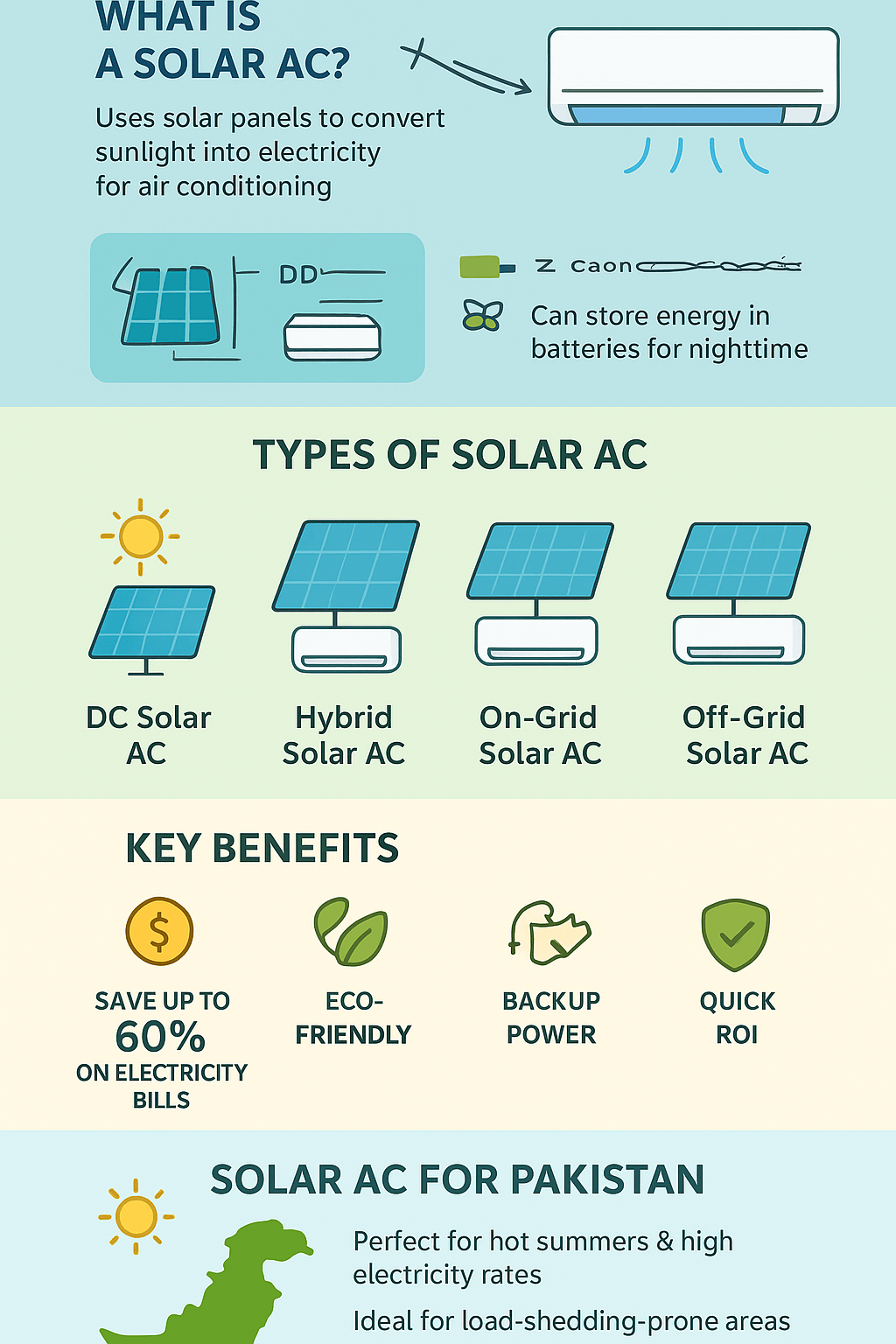
Imagine an air conditioner that’s powered by sunlight instead of costly electricity—that’s a solar panel AC. It relies on photovoltaic solar energy, where rooftop or ground-mounted solar panels soak up sunlight and convert it into direct current (DC) electricity. This DC power can then:
-
Power a DC-optimized AC unit directly, or
-
Be sent through an inverter to convert it into alternating current (AC) for conventional air conditioners.
Some systems even store excess energy in batteries, keeping you cool even after the sun sets—like having sunshine in a box!
DC Solar AC vs. Hybrid Solar AC
DC Solar AC
These systems are built for efficiency. They run directly on the DC electricity from solar panels—no inverter needed—cutting energy losses and complexity. They’re practical for off-grid setups, remote cabins, RVs, and situations where every watt counts.
Hybrid Solar AC
This flexible option lets you switch seamlessly between solar, battery, and grid power. During sunny days, it runs on solar energy; at night or during cloudy weather, it automatically taps into your home’s electricity supply. Think of it as the “best of both worlds.”
On-Grid vs. Off-Grid Solar AC Systems
On-Grid (Grid-Tied)
These setups feed excess solar power back into the national grid via net metering. This helps offset your electricity bills—but keep in mind, they won’t work during power outages, as utilities prevent backfeeding.
Off-Grid
Perfect for remote areas or places with unreliable electricity, these standalone systems store solar energy in batteries and work independently of the grid.
Hybrid (Best of Both)
Combining on-grid and off-grid, hybrid systems offer solar savings, battery backup, and grid fallback when needed—ideal for smart, future-ready homes.
Cool Benefits of Solar Energy for Cooling
-
Slash your electricity bill – Say goodbye to rising utility costs—solar cuts your AC’s energy demand dramatically.
-
Eco-friendly & clean – No more fossil fuel emissions—just fresh, guilt-free cooling.
-
Reliable even during outages – Some solar ACs keep working when the grid doesn’t, thanks to battery backup.
-
Low maintenance, built to last – Solar panels need little upkeep, and the efficient, fewer-moving-parts design makes the whole system quieter and durable.
-
Long-term savings & ROI – While installation might cost more upfront, the payoff comes quickly via lower power bills and rising energy prices—especially relevant for Pakistan’s escalating electricity rates.
Bringing It to Life for Pakistani Homeowners
With Pakistan’s hot summers and steep electricity prices, solar-powered cooling offers a breath of fresh air—literally. Whether you’re battling frequent load-shedding or simply trying to shrink your monthly utility bill, a solar AC system—whether DC-powered, hybrid, on-grid, or off-grid—presents a smart, sustainable solution. You get cool comfort powered by sunshine, backed by batteries or the grid as needed, with minimal maintenance and maximum savings.
Plus, with an ROI typically within a few years, installing a solar air conditioner in Pakistan isn’t just a green choice—it’s a financially wise move for households and businesses alike.
Solar Panel AC Price in Pakistan (2025 Update)
If you’ve been feeling the pinch of rising electricity bills, you’re not alone. Many homeowners and businesses in Pakistan are now looking at solar-powered air conditioners as a long-term solution to beat the heat and cut monthly costs. The good news? In 2025, the market for solar panel ACs in Pakistan is more competitive than ever, meaning better prices, more choices, and improved energy efficiency.
Below is a detailed breakdown of solar AC prices in Pakistan 2025 based on capacity and brand, so you can make an informed decision before investing.
Price Range by Capacity
1-Ton Solar AC Price in Pakistan
Perfect for small rooms or offices, a 1-ton solar air conditioner can efficiently cool areas of up to 120 sq. ft. In 2025, prices for 1-ton models generally range between PKR 160,000 – 220,000, depending on whether it’s a DC or hybrid system and the brand you choose.
1.5-Ton Solar AC Price in Pakistan
The most popular choice for Pakistani households, the 1.5-ton solar AC is ideal for rooms of 150–180 sq. ft. Expect to pay between PKR 210,000 – 280,000 for a good quality model from brands like Gree, Haier, or Kenwood. Hybrid systems in this category can seamlessly switch between solar and grid power, offering the best of both worlds.
2-Ton Solar AC Price in Pakistan
For large halls, shops, or big living rooms, a 2-ton solar AC is the way to go. In 2025, these units typically cost between PKR 300,000 – 420,000, especially if you opt for premium brands or higher-efficiency inverter technology.
Price Range by Brand (03-Jul-2026)
-
Gree Solar AC Price in Pakistan – Known for reliability and inverter efficiency, Gree models are priced between PKR 210,000 – 400,000 depending on tonnage.
-
Haier Solar AC Price in Pakistan – Stylish designs and smart energy features, prices range from PKR 200,000 – 380,000.
-
Dawlance Solar AC Price in Pakistan – Affordable yet durable, priced between PKR 190,000 – 350,000.
-
Kenwood Solar AC Price in Pakistan – Excellent cooling with eco-friendly performance, ranging from PKR 210,000 – 370,000.
-
Inverex Solar AC Price in Pakistan – Specializes in renewable energy products, prices between PKR 220,000 – 400,000.
-
PEL Solar AC Price in Pakistan – Budget-friendly with decent efficiency, starting from PKR 185,000 – 340,000.
Solar AC Price List 2025 in Pakistan
| Brand | Model | Capacity (Ton) | Price (PKR) |
|---|---|---|---|
| Gree | GS-12FITH1W Inverter | 1.0 | 170,000 – 230,000 |
| Gree | GS-18FITH3W Inverter | 1.5 | 210,000 – 280,000 |
| Haier | HSU-12HFDC Inverter | 1.0 | 170,000 – 220,000 |
| Haier | HSU-18HFDC Inverter | 1.5 | 200,000 – 270,000 |
| Dawlance | LVS Pro Inverter 12 | 1.0 | 150,000 – 210,000 |
| Dawlance | LVS Pro Inverter 18 | 1.5 | 190,000 – 260,000 |
| Kenwood | KDC-1225S Inverter | 1.0 | 180,000 – 230,000 |
| Kenwood | KDC-1825S Inverter | 1.5 | 210,000 – 280,000 |
| Inverex | Solar Hybrid 1.5 Ton | 1.5 | 230,000 – 300,000 |
| Inverex | Solar Hybrid 2.0 Ton | 2.0 | 330,000 – 400,000 |
| PEL | Inverter T3 Pro 12 | 1.0 | 165,000 – 205,000 |
| PEL | Inverter T3 Pro 18 | 1.5 | 180,000 – 260,000 |
This solar panel AC price data is automatically fetched from the real‑time Pakistani market using our connected monitoring system, ensuring up‑to‑date and accurate rates.
Pro Tip: When comparing prices, factor in the cost of solar panels, mounting structure, and inverter (if needed). While the upfront investment might seem high, the savings on electricity bills—especially with Pakistan’s current tariff hikes—make solar ACs a wise long-term choice.
Factors Affecting Solar AC Price in Pakistan
If you’ve ever wondered why one solar-powered AC in Pakistan costs a lot more than another, the answer lies in a mix of technology, quality, and market conditions. Understanding these factors will help you make a smart investment that balances cost, performance, and long-term savings.
1. Brand & Technology (DC Inverter vs. Hybrid)
Well-known brands like Gree, Haier, Kenwood, and Inverex often charge a premium, but they deliver better energy efficiency, durability, and after-sales support.
-
DC Inverter Solar ACs: Run directly on DC electricity from solar panels, offering maximum efficiency and minimal conversion loss.
-
Hybrid Solar ACs: Can switch between solar, battery, and grid power, giving you more flexibility—especially during cloudy days or at night.
The more advanced the technology, the higher the price tag—but also the better the energy savings.
2. Solar Panel Wattage & Quality
The solar panels powering your AC are just as important as the unit itself. High-wattage, Tier-1 solar panels from brands like Longi, Canadian Solar, or JA Solar generate more power, ensuring your AC runs smoothly even in peak summer heat. Better-quality panels may cost more initially, but they’re more durable and efficient, reducing your lifetime cost per unit of electricity.
3. Battery Backup or Grid Connection
If your solar AC is paired with a battery storage system, expect the cost to rise significantly. While batteries (like Lithium-ion or Gel) allow you to run the AC during power outages or at night, they can add PKR 150,000 – 400,000 to your setup cost.
On the other hand, grid-tied solar ACs are cheaper since they don’t require battery storage—though they won’t work during load-shedding unless paired with a hybrid inverter and battery backup.
4. Installation & Maintenance Costs
Proper installation is key for peak performance. Costs vary depending on:
-
Roof type (flat, sloped, or tiled)
-
Mounting structure quality (GI, aluminum)
-
Wiring and safety equipment
Choosing a certified installer might cost a bit more upfront but ensures better system efficiency and fewer future repairs. Maintenance for solar ACs is generally low, but regular cleaning of solar panels is essential for consistent output.
5. Import Taxes & Government Policies
In Pakistan, the price of solar ACs can be affected by import duties, currency exchange rates, and government incentives. A weaker rupee means higher prices for imported AC units and solar components. On the bright side, any government subsidy or net-metering policy can significantly improve your return on investment, making solar cooling more affordable in the long run.
How Many Solar Panels Are Needed to Run an AC?
One of the first questions people ask before switching to a solar-powered air conditioner in Pakistan is, “How many solar panels do I need?” The answer depends on your AC’s tonnage, daily usage hours, and whether you’re using batteries or a grid-tied system.
1. Calculating Solar Panel Requirement Based on Tonnage & Usage
The cooling capacity of your AC determines its power consumption. Generally:
-
1-ton AC: Consumes around 1–1.2 kW per hour
-
1.5-ton AC: Consumes around 1.5–1.8 kW per hour
-
2-ton AC: Consumes around 2–2.5 kW per hour
Now, factor in your daily usage hours. For example, running a 1.5-ton inverter AC for 8 hours a day requires about 12–14 kWh of electricity.
2. Example – Solar Requirement for a 1.5-Ton AC
Let’s say you have a 1.5-ton DC inverter AC and you want to run it entirely on solar power during the day.
-
AC power consumption: ~1.7 kW per hour
-
Daily usage: 8 hours → 1.7 × 8 = 13.6 kWh needed daily
-
Average solar panel output in Pakistan: ~4–5 kWh per 550W panel (depending on location & sunlight)
So, 3–4 high-efficiency 550W solar panels will be enough to run the AC during the day without batteries. If you want to run it day and night, you’ll need extra panels plus a battery bank to store energy.
3. Role of Inverter & Battery Size in Performance
Inverter Size
The inverter is the heart of your solar AC system—it converts the DC electricity from your panels into AC electricity for your air conditioner (unless it’s a DC solar AC).
-
For a 1.5-ton AC, you’ll typically need a 2–3 kW solar inverter to handle peak loads and ensure smooth operation.
Battery Bank Size
If you want your AC to run at night or during cloudy hours, you’ll need deep-cycle solar batteries (Lithium-ion or Gel). The capacity depends on your nighttime usage:
-
Example: Running a 1.5-ton AC for 4 hours at night (~6.8 kWh) would require around 6–8 kWh of battery storage.
Pro Tip: For best results, pair your solar AC with Tier-1 solar panels, a high-quality inverter, and efficient batteries. This setup not only keeps your room cool but also ensures long-term savings despite Pakistan’s rising electricity tariffs.
Best Solar AC Brands in Pakistan (2025)
When it comes to investing in a solar-powered AC in Pakistan, choosing the right brand is just as important as picking the right capacity. In 2025, the market is packed with options—from premium high-efficiency models to budget-friendly solutions—so there’s something for every home and budget. Here’s a breakdown of the best solar AC brands in Pakistan, their price ranges, features, and what makes them stand out.
1. Gree Solar AC – Premium Cooling with Maximum Energy Savings
Gree has built a solid reputation for its inverter technology and reliable performance in Pakistan’s extreme weather. Their solar-compatible ACs deliver:
-
Price range (2025): PKR 210,000 – 400,000 depending on tonnage and model
-
Features: Powerful cooling, energy-efficient DC inverter compressors, quiet operation, and advanced filters for cleaner air
-
Why choose Gree? High SEER ratings mean lower electricity bills, making it perfect for those seeking long-term energy savings.
2. Haier Solar AC – Smart Hybrid Options for Flexible Use
Haier offers some of the most stylish and technologically advanced hybrid solar ACs in Pakistan. These models can seamlessly switch between solar, battery, and grid power.
-
Price range (2025): PKR 200,000 – 380,000
-
Features: Smart inverter technology, WiFi control in select models, rust-proof outdoor units, and fast cooling
-
Why choose Haier? Ideal for homes that want day-and-night operation without worrying about cloudy weather or load-shedding interruptions.
3. Dawlance Solar AC – Reliability with Strong Warranty Support
Known for its durability and affordable pricing, Dawlance remains a popular choice for budget-conscious buyers.
-
Price range (2025): PKR 190,000 – 350,000
-
Features: Long-lasting copper condensers, eco-friendly refrigerants, and up to 10-year compressor warranty
-
Why choose Dawlance? Reliable after-sales service across Pakistan and competitive pricing without compromising on build quality.
4. Inverex Solar AC – High-Efficiency Solutions for Serious Energy Savers
Inverex, a brand famous for solar products, brings high-performance AC units designed for maximum energy independence.
-
Price range (2025): PKR 220,000 – 400,000
-
Features: Designed for direct solar integration, premium inverters, and compatibility with large solar arrays
-
Why choose Inverex? Perfect for those wanting off-grid capability or high-efficiency hybrid setups to minimize grid dependency.
5. Kenwood & PEL – Budget-Friendly Cooling Solutions
For those on a tighter budget, Kenwood and PEL offer efficient, solar-compatible inverter ACs at more affordable rates.
-
Kenwood Price range (2025): PKR 210,000 – 370,000
-
PEL Price range (2025): PKR 185,000 – 340,000
-
Features: Energy-saving modes, decent build quality, inverter compressors, and sleek designs
-
Why choose Kenwood or PEL? Great for small homes, shops, or offices looking for cost-effective solar cooling without a hefty investment.
Solar AC Installation Cost in Pakistan
Buying a solar-powered AC is only half the story—the real magic happens during installation. The right setup ensures your system runs efficiently, lasts longer, and delivers the energy savings you’re expecting. But before you dive in, it’s important to understand what’s included in the installation cost and what factors can influence it.
1. Components Included in Solar AC Installation
When you get a solar AC system installed in Pakistan, you’re not just paying for the air conditioner. A complete setup usually includes:
-
Solar Panels – The primary source of power, sized according to your AC’s load requirement.
-
Solar Inverter – Converts DC power from panels into AC electricity for your AC (unless it’s a direct DC solar AC).
-
Batteries (Optional) – Store energy for night use or during load-shedding; common in hybrid and off-grid setups.
-
Mounting Structure – Strong, weather-resistant frames (usually aluminum or galvanized iron) to hold panels securely.
-
Cabling & Protection Devices – High-quality wires, breakers, and surge protection for safe operation.
2. Average Solar AC Installation Charges in Pakistan (2025)
Installation costs vary based on system size, complexity, and location. On average, you can expect:
-
Small setups (1-ton DC AC, no battery) → PKR 25,000 – 40,000 installation cost
-
Medium setups (1.5-ton hybrid AC with partial battery backup) → PKR 40,000 – 70,000 installation cost
-
Large setups (2-ton hybrid AC with full battery bank) → PKR 70,000 – 120,000 installation cost
Note: These figures cover labor, mounting, and wiring but exclude the actual cost of solar panels, inverter, batteries, and AC unit.
3. Tips for Choosing a Certified Solar Installer
Your installer plays a huge role in your system’s performance and lifespan. Here’s how to pick the right one:
-
Check Certifications & Experience – Look for installers certified by AEDB (Alternative Energy Development Board) or reputable solar training programs.
-
Ask for Site Inspection – A professional should inspect your home’s roof, sunlight exposure, and load requirements before giving a quote.
-
Request a Detailed Proposal – It should include the equipment list, warranty terms, and an estimated energy savings report.
-
Read Reviews & Ask for References – Feedback from previous customers can tell you a lot about reliability and after-sales service.
-
Don’t Just Go for the Lowest Price – Cheaper isn’t always better. Poor installation can reduce efficiency and lead to costly repairs later.
Benefits of Using Solar Panel AC in Pakistan
Switching to a solar-powered air conditioner isn’t just about staying cool—it’s about making a smart financial and environmental choice. In a country like Pakistan, where summer heat can be brutal and electricity bills keep climbing, a solar AC system offers multiple advantages that go far beyond comfort.
1. Zero Electricity Bill for Cooling
With a properly sized solar panel AC setup, your cooling needs can run entirely on free sunlight. That means no more worrying about peak summer bills eating up your budget. While the initial investment may seem high, the day you see a PKR 0 cooling cost on your bill, you’ll know it was worth every rupee.
2. Works During Load-Shedding
Load-shedding is a reality in many parts of Pakistan, but it doesn’t have to interrupt your comfort. A hybrid solar AC with battery backup can keep running even when the grid goes down—perfect for long summer blackouts. You stay cool, productive, and stress-free, no matter what’s happening outside.
3. Environmentally Friendly Cooling
Unlike conventional ACs that rely on electricity generated from fossil fuels, solar air conditioners use clean, renewable energy. That means fewer greenhouse gas emissions and a smaller carbon footprint. By choosing solar cooling, you’re actively contributing to a greener, healthier Pakistan for future generations.
4. Long-Term Savings & Increased Property Value
Yes, a solar AC system in Pakistan can be a big upfront investment—but over time, it pays for itself through massive energy savings. Plus, homes equipped with solar technology often have higher resale values because buyers know they’re getting a property with lower running costs and sustainable features.
Government Incentives & Net Metering for Solar ACs
One of the best things about investing in a solar panel AC system in Pakistan is that you’re not just saving on electricity bills—you can also benefit from government-backed incentives that make your investment even more rewarding.
NEPRA’s Net Metering Policy
The National Electric Power Regulatory Authority (NEPRA) introduced the net metering policy to promote renewable energy adoption in Pakistan. With net metering, any extra electricity your solar panels generate (beyond what your AC and home consume) is sent back to the national grid. In return, you get credits on your electricity bill, effectively reducing your monthly cost to almost nothing—or even earning you a surplus in some months.
How Net Metering Helps Offset Costs
For homeowners running a solar-powered AC, summer months often produce more solar energy than needed. Thanks to net metering, that extra energy isn’t wasted—it’s banked as credit. This means your solar AC system continues to save you money throughout the year, even during cooler months when your AC usage is low.
Possible Subsidies or Financing Schemes
While Pakistan doesn’t yet have large-scale subsidies for residential solar AC systems, there are bank financing schemes and easy installment plans from solar companies that make going solar more affordable. In some cases, provincial governments or development programs may introduce limited-time incentives for renewable energy adoption, so it’s worth keeping an eye on official announcements.
Pro Tip: Before installing your solar AC with net metering, make sure your installer is NEPRA-certified and your solar system meets the technical requirements for approval. This ensures you can legally sell your extra power back to the grid and maximize your returns.
Solar AC Maintenance & Warranty
Installing a solar panel AC is just the first step toward energy-efficient cooling—keeping it in top shape ensures it runs smoothly for years while delivering maximum savings. The good news? Solar AC systems in Pakistan require minimal upkeep compared to traditional air conditioners, but a little care goes a long way.
Cleaning & Maintenance Tips
Dust and dirt can reduce the efficiency of both your solar panels and your AC unit.
-
Clean the panels every 2–3 weeks with plain water to remove dust buildup. Avoid using harsh chemicals.
-
Check your AC filters monthly during peak usage seasons and clean or replace them as needed.
-
Inspect wiring and mounting structures annually to ensure everything is secure and rust-free.
Battery Care for Hybrid Systems
If you have a hybrid solar AC with battery backup, proper battery maintenance is crucial:
-
Avoid deep discharging your battery frequently—it shortens its lifespan.
-
Keep batteries in a cool, dry, and well-ventilated space.
-
Follow the manufacturer’s charging guidelines to prevent overcharging or undercharging.
Typical Warranty Periods by Brand
Most solar AC brands in Pakistan offer warranties that protect your investment:
-
AC Units: Typically 3–5 years on parts and 10 years on the compressor.
-
Solar Panels: 10–25 years performance warranty, depending on brand quality.
-
Inverters & Batteries: Usually 2–5 years, with high-end models offering longer coverage.
Pro Tip: Always keep your warranty card and installation receipts safe. Many brands require proof of purchase for any claims, and using authorized service centers ensures your warranty remains valid.
Q: What is the price of a 1.5-ton solar AC in Pakistan?
The price of a 1.5-ton solar AC in Pakistan in 2025 typically ranges between PKR 180,000 to PKR 280,000, depending on the brand, whether it’s a DC inverter or hybrid model, and if the package includes solar panels, inverter, and installation. Prices can vary due to import costs, exchange rates, and seasonal demand.
Q: Can I run my AC only on solar panels without batteries?
Yes, you can run an AC directly on solar panels without batteries if you opt for a grid-tied or on-grid solar AC system. However, this setup will only work during daylight hours when sunlight is available. If you want your AC to run at night or during load-shedding, you’ll need a hybrid solar system with batteries for energy storage.
Q: How many solar panels do I need for a 1-ton AC?
On average, a 1-ton solar AC requires 3 to 4 solar panels of 450–550 watts each, depending on daily usage hours, panel efficiency, and sunlight availability in your area. For maximum efficiency, pair the panels with a compatible inverter and ensure proper installation by certified technicians.
Q: Which is the best brand for solar-powered AC in Pakistan?
Some of the best solar AC brands in Pakistan for 2025 include Gree, Haier, Dawlance, Inverex, Kenwood, and PEL. Gree and Haier are known for premium performance and energy efficiency, Dawlance offers affordable yet reliable options, while Inverex specializes in high-efficiency hybrid systems. Your choice should depend on your budget, cooling needs, and whether you want an on-grid or hybrid solution.
Q: Does solar AC work at night?
A solar AC can work at night if it’s connected to a battery backup (hybrid system) or the electricity grid. Without batteries, a purely solar-powered AC won’t run after sunset since solar panels stop producing electricity. For 24/7 cooling, a hybrid solar AC system is the best choice.
Conclusion – Is a Solar AC Worth It in Pakistan?
Switching to a solar panel AC in Pakistan is more than just a trend—it’s a smart, future-proof investment. With the power to eliminate or drastically reduce your electricity bills, operate even during load-shedding, and reduce your carbon footprint, solar-powered cooling is transforming the way Pakistanis beat the heat.
In 2025, the case for going solar has never been stronger. Solar panel prices are becoming more competitive, NEPRA’s net metering policy allows you to sell excess electricity back to the grid, and the variety of DC inverter and hybrid solar AC models on the market means there’s something for every budget and home size.
If you’re tired of high electricity bills and unpredictable power cuts, now is the perfect time to make the switch.
✅ Compare prices across top solar AC brands in Pakistan like Gree, Haier, Dawlance, Inverex, Kenwood, and PEL.
✅ Choose based on your usage, budget, and energy needs.
✅ Invest in a certified installation to maximize performance and warranty benefits.
Final Word: A solar AC is not just a cooling solution—it’s a step toward energy independence, financial savings, and a greener future for Pakistan.