Solar energy is no longer just a futuristic concept in Pakistan—it’s quickly becoming a mainstream solution for homes, businesses, and industries looking to cut electricity costs and embrace renewable energy. With power outages and rising electricity bills becoming a common concern, more and more Pakistanis are turning to solar panels as a reliable, eco-friendly alternative.
Before investing in a solar energy system, understanding the price of one solar panel in Pakistan is crucial. Prices can vary based on brand, wattage, efficiency, and installation requirements, so knowing what to expect will help you plan your budget effectively.
The adoption of solar power in Pakistan is growing rapidly, supported by government incentives and the increasing awareness of environmental sustainability. From small residential solar panels to large commercial setups, the trend shows no signs of slowing down. Whether you are looking to power your home, office, or factory, staying informed about the latest solar panel prices, types, and technologies in 2025 will ensure you make a smart, long-term investment.
By exploring the latest price trends and understanding the factors that influence costs, this guide will help you navigate Pakistan’s solar market with confidence—so you can enjoy uninterrupted electricity while contributing to a greener future.
Benefits of Investing in Solar Panels
Investing in solar panels in Pakistan is no longer just an environmentally friendly choice—it’s a smart financial decision. As more households and businesses explore renewable energy solutions, the advantages of going solar are becoming increasingly clear.
Reduce Electricity Bills
One of the most immediate benefits of installing solar panels is the significant reduction in monthly electricity bills. By generating your own power, you rely less on the national grid, which not only lowers costs but also protects you from frequent electricity price hikes. Over time, these savings can cover the initial investment in your solar system.
Sustainable and Renewable Energy Source
Solar energy is clean, sustainable, and completely renewable. Unlike fossil fuels, it doesn’t emit harmful gases, making it a key solution for combating climate change. By switching to solar, you contribute to a greener Pakistan while reducing your carbon footprint.
Off-Grid Energy Solution for Rural Areas
For rural areas and remote locations with limited access to the national grid, solar panels provide a reliable off-grid energy solution. With the right setup—including batteries and inverters—homes and businesses can enjoy uninterrupted electricity, even during power outages.
Long-Term Savings and Return on Investment
Although the initial investment may seem high, solar panels offer long-term financial benefits. High-quality panels typically last 20–25 years, providing consistent energy and reducing reliance on costly electricity. Over time, the return on investment (ROI) becomes substantial, making solar power a cost-effective solution for both residential and commercial users.
Investing in solar panels in Pakistan is more than just a way to save money—it’s a commitment to sustainability, energy independence, and long-term financial security.
Factors Affecting the Price of a Solar Panel in Pakistan
When considering solar energy for your home or business, it’s important to understand that solar panel prices in Pakistan are influenced by multiple factors. Knowing these details will help you make a smart investment and avoid unexpected costs.
Wattage & Power Output
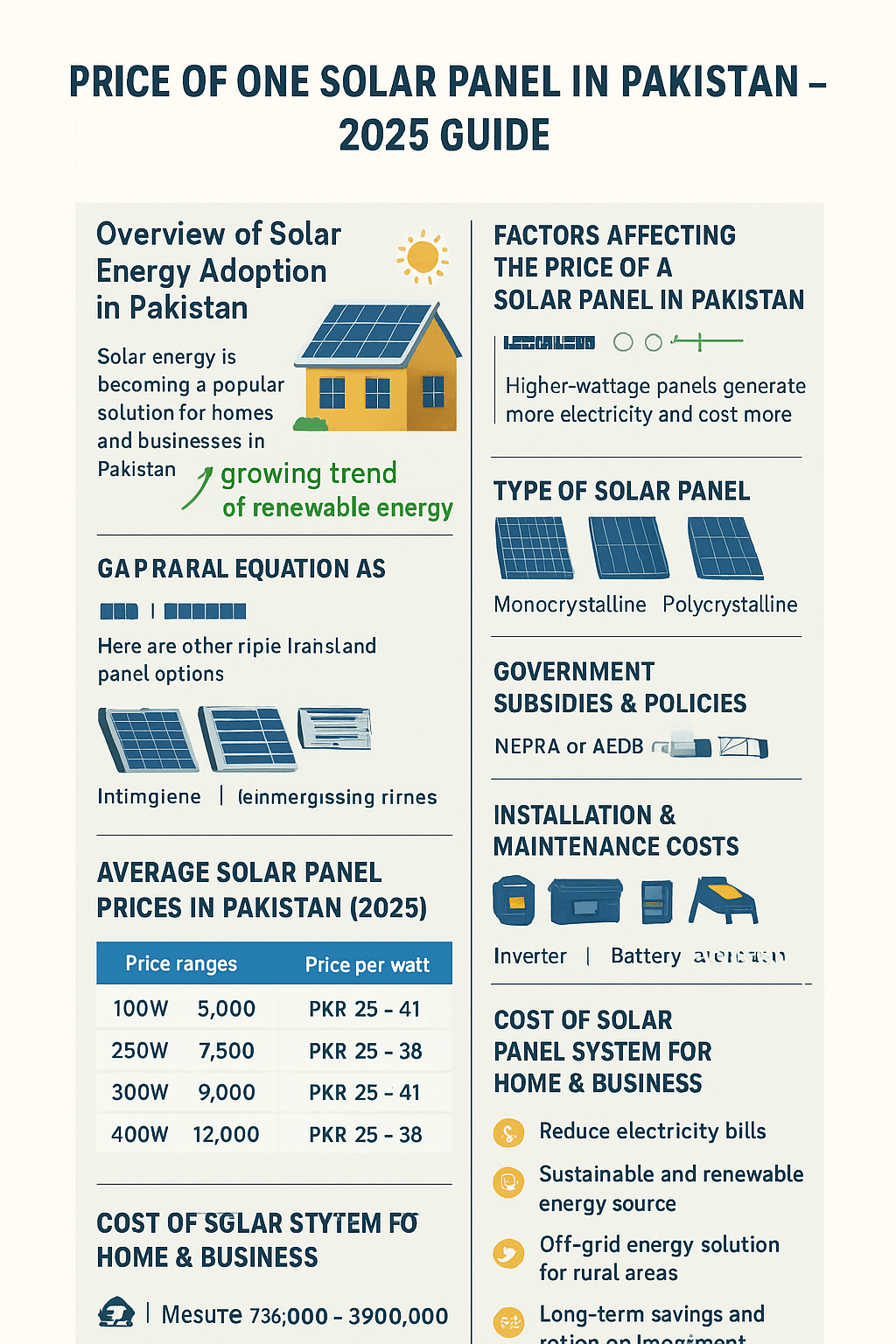
One of the biggest factors affecting solar panel prices is wattage. Panels come in different capacities such as 100W, 250W, and 300W, and each serves a different energy need. Higher-wattage panels generate more electricity, which means they cost more. For example, a 300W panel can power multiple appliances, while a 100W panel is suitable for small devices or LED lights. Choosing the right wattage depends on your household or business energy consumption.
Brand & Quality
The brand of a solar panel also plays a key role in pricing. Tier-1 international brands like Canadian Solar, Jinko, Trina, and LONGi are known for reliability, efficiency, and longer warranties, but they come with a higher price tag. On the other hand, local Pakistani panels are more affordable but may vary in performance and durability. Investing in a reputed brand can save you money in the long run due to lower maintenance and higher energy output.
Type of Solar Panel
There are three main types of solar panels available in Pakistan:
-
Monocrystalline: High efficiency, sleek design, higher price. Ideal for limited rooftop space.
-
Polycrystalline: Slightly lower efficiency, moderately priced, widely used for residential and commercial setups.
-
Thin-film: Lightweight and flexible, but less efficient, often used in specialized applications.
Government Subsidies & Policies
Government policies also influence solar panel costs. Agencies like NEPRA (National Electric Power Regulatory Authority) and AEDB (Alternative Energy Development Board) provide incentives and rebates for renewable energy adoption. These subsidies can reduce upfront costs significantly, making solar energy more accessible to households and businesses.
Installation & Maintenance Costs
The cost of a solar panel doesn’t end at purchase. Installation and maintenance—including inverters, batteries, mounting frames, and cables—add to the total investment. Hiring professional installers ensures safety and optimal performance, while regular maintenance keeps your system running efficiently for years.
Understanding these factors will help you estimate the true cost of solar panels in Pakistan and choose a solution that fits both your budget and energy needs.
Average Solar Panel Prices in Pakistan (2025)
Understanding the average solar panel prices in Pakistan is essential for anyone considering a shift to solar energy. Prices can vary based on wattage, brand, type, and region. Let’s break down the current pricing trends to help you make an informed decision.
Price Ranges by Wattage
Their wattage often determines the cost of solar panels in Pakistan. Here’s an overview of the average prices for different wattages:
-
100W Panels: Typically priced between PKR 3,000 to PKR 4,000. These are suitable for small-scale applications like garden lights or small appliances.
-
250W Panels: Ranging from PKR 7,500 to PKR 10,000. Ideal for small homes or offices with moderate energy needs.
-
300W Panels: Costing between PKR 9,000 to PKR 12,000. These panels offer a balance between cost and energy output, making them popular for residential setups.
-
400W Panels: Priced around PKR 12,000 to PKR 15,000. Suitable for larger homes or small businesses aiming to reduce electricity bills.
Price Per Watt (PKR/W)
On average, the price per watt for solar panels in Pakistan ranges from PKR 25 to PKR 41, depending on factors like brand, quality, and region.
Differences in Residential vs. Commercial Solar Panels
| Category | Residential Panels | Commercial Panels |
|---|---|---|
| Wattage Range | 100W to 400W | 400W to 550W+ |
| Price per Watt | PKR 28–41 | PKR 25–38 |
| Typical Use | Homes, small offices | Factories, large businesses |
| Installation Scale | Small to medium setups | Large-scale installations |
Note: Prices may vary based on location and supplier.
Cost of Solar Panel System for Home & Business
As electricity bills continue to rise and power outages become more frequent, investing in a solar panel system has become a practical solution for many in Pakistan. Understanding the costs associated with different system sizes can help you make an informed decision.
Small Home Systems (1–3 kW)
Ideal for small households or backup power, these systems can power essential appliances like lights, fans, and mobile chargers.
-
1 kW System: Approximately PKR 196,000
-
3 kW System: Approximately PKR 390,000
Note: Prices may vary based on brand and installation specifics.
Medium Systems (3–10 kW)
Suitable for medium-sized homes or small businesses, these systems can handle higher loads, including air conditioners and additional appliances.
-
5 kW System: Approximately PKR 750,000
-
8 kW System: Approximately PKR 1,000,000
Note: Prices may vary based on brand and installation specifics.
Large Commercial Systems (10 kW+)
Designed for larger businesses or industrial applications, these systems can significantly reduce electricity costs and ensure a steady power supply.
-
10 kW System: Approximately PKR 1,300,000 to PKR 1,700,000
Note: Prices may vary based on brand and installation specifics.
Inverter and Battery Costs for Off-Grid Setup
For off-grid systems, an inverter and battery storage are essential components.
-
Inverter Costs:
-
1 kW Off-Grid Inverter: PKR 30,000 – PKR 40,000
-
3 kW Off-Grid Inverter: PKR 70,000 – PKR 90,000
-
-
Battery Costs:
-
Tubular Batteries: PKR 45,000 – PKR 70,000
-
Lithium-Ion Batteries: PKR 245,000 – PKR 275,000
-
Note: Prices may vary based on brand and capacity.
How to Choose the Best Solar Panel in Pakistan
Choosing the right solar panel is one of the most important steps in setting up a solar energy system. With so many options available in Pakistan, it’s essential to consider several factors to ensure you get the best value and long-term performance.
Factors to Consider: Efficiency, Warranty, and Brand Reputation
Efficiency determines how much sunlight a panel can convert into usable electricity. Higher efficiency panels generate more power in limited space, which is especially important if your rooftop area is small.
Warranty is another critical factor—most Tier-1 brands like Canadian Solar, Jinko, Trina, and LONGi offer 25-year performance warranties, providing peace of mind. Brand reputation also matters. Established brands are more reliable in terms of quality, durability, and after-sales support, whereas local or lesser-known brands might be cheaper but may lack consistency.
Checking Energy Output (kWh/day)
Before making a purchase, evaluate the energy output of the solar panel. This is typically measured in kilowatt-hours per day (kWh/day). Understanding how much energy a panel produces helps you match the system size to your household or business energy needs, avoiding over- or under-sizing.
Comparing Prices Per Watt and Total System Cost
While price is a key consideration, don’t focus solely on upfront costs. Compare the price per watt and calculate the total system cost, including inverters, batteries (for off-grid setups), and installation. Sometimes, slightly higher-priced panels offer better long-term savings due to greater efficiency and durability.
Tier-1 vs Tier-2 Panels: Pros & Cons
| Panel Type | Pros | Cons |
|---|---|---|
| Tier-1 | High efficiency, long warranty, reliable | Higher upfront cost |
| Tier-2 | Lower initial cost, easier to source | Lower efficiency, shorter lifespan, variable quality |
By carefully evaluating these factors—efficiency, warranty, energy output, and cost—you can choose a solar panel in Pakistan that meets your energy needs, fits your budget, and ensures a reliable power supply for years to come.
FAQs
Q1: How much does a 250W solar panel cost in Pakistan?
The price of a 250W solar panel in Pakistan typically ranges between PKR 7,500 to PKR 10,000, depending on the brand, quality, and type of panel. International Tier-1 brands like Canadian Solar, Jinko, and Trina are slightly more expensive but offer higher efficiency, longer warranties, and better durability compared to local panels. Always check the panel’s specifications, warranty, and energy output before making a purchase.
Q2: Which brand solar panel is best for homes?
For residential use, Tier-1 international brands are generally the best choice. Brands like Canadian Solar, Jinko, Trina, and LONGi are known for high efficiency, reliability, and long-term performance. They may cost more upfront, but they provide consistent energy output, lower maintenance, and a 20–25 year performance warranty, making them a better long-term investment compared to cheaper local alternatives.
Q3: Can I install a solar panel myself?
While small solar kits can sometimes be installed by tech-savvy individuals, it’s generally recommended to hire a professional solar installer. Proper installation ensures safety, maximizes energy output, and prevents damage to the panels, wiring, or inverter. Certified installers can also help with warranties and ensure your system complies with local regulations.
Q4: Does the government provide subsidies for solar panels?
Yes, the Pakistani government, through agencies like NEPRA (National Electric Power Regulatory Authority) and AEDB (Alternative Energy Development Board), offers incentives and subsidies for renewable energy projects. These programs can reduce upfront costs and make solar energy more affordable for homes and businesses. The availability of subsidies may vary by province and system size, so it’s best to consult local dealers for the latest updates.
Q5: How long does a solar panel last in Pakistan?
Most high-quality solar panels in Pakistan have a lifespan of 20 to 25 years, with Tier-1 brands often lasting even longer. Efficiency may slightly decline over time, but regular maintenance—like cleaning panels and checking connections—can help maintain performance. Investing in durable panels ensures long-term savings and reliable energy production for decades.
Conclusion
Understanding the price of solar panels in Pakistan is the first step toward making a smart investment in renewable energy. From factors like wattage, brand, and panel type to installation, inverter, and battery costs, several elements determine the overall cost of a solar system.
While this guide provides an overview of average prices and system sizes—from small home setups to large commercial installations—it’s always a good idea to consult local solar dealers for accurate quotes tailored to your energy needs and location. Local experts can help you choose the right panels, inverters, and batteries, ensuring maximum efficiency and long-term savings.
Investing in solar panels is more than just a financial decision—it’s a step toward sustainable and reliable energy, reduced electricity bills, and energy independence. By embracing solar energy in Pakistan today, you’re not only securing long-term benefits for your home or business but also contributing to a cleaner, greener future.