Pakistan is increasingly turning to solar energy as a reliable and sustainable solution to its electricity challenges. With frequent load shedding and rising electricity costs, more households and businesses are exploring solar energy investment in Pakistan as a long-term strategy.
One of the key considerations for anyone looking into solar power is understanding the ROI of solar panels in Pakistan. How long will it take for the savings on electricity bills to cover the initial investment? What factors influence the payback period, and how can you maximize returns?
As interest in renewable energy ROI continues to grow, it’s clear that solar panels are not just an eco-friendly choice—they’re also a smart financial decision. By evaluating costs, government incentives, and energy usage, you can make an informed choice that benefits both your wallet and the environment.
What Is ROI for Solar Panels?
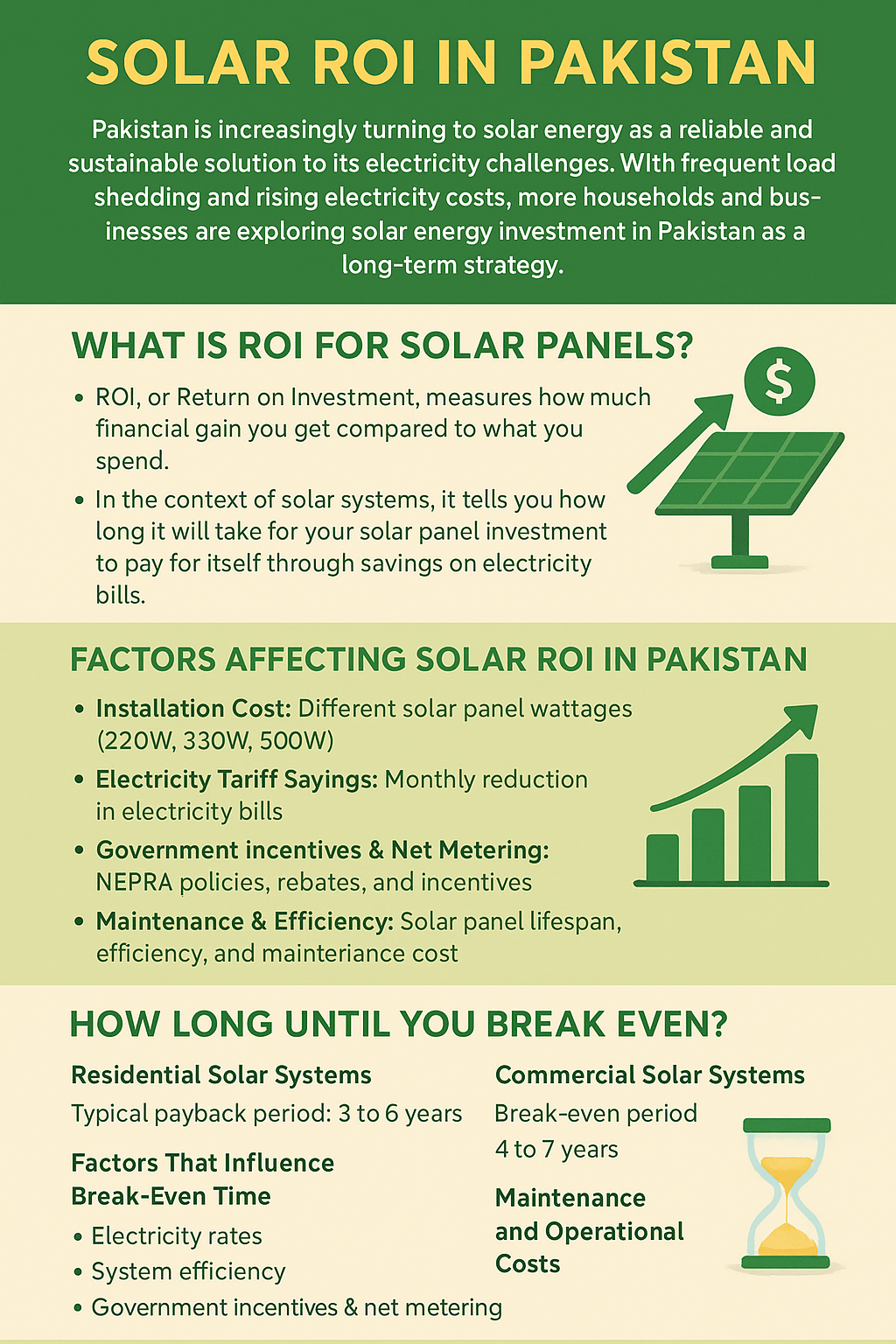
When considering solar energy, one of the most important questions is: What is the ROI for solar panels? ROI, or Return on Investment, measures how much financial gain you get compared to what you spend. In the context of solar systems, it tells you how long it will take for your solar panel investment to pay for itself through savings on electricity bills.
Calculating ROI for solar panels involves comparing the solar panel cost vs savings over time. You start by looking at the total cost of installing your solar system—including panels, inverter, batteries (if any), and installation fees. Then, you compare that to the expected savings on your monthly electricity bills. The higher your energy consumption and electricity rates, the faster your return on investment solar will be realized.
Another factor to consider is long-term solar savings. Even after breaking even, your solar system continues to generate free electricity for years, creating ongoing savings and reducing your dependence on the grid. This makes solar panels not just an environmentally friendly choice but also a smart financial investment in the long run.
Factors Affecting Solar ROI in Pakistan
When it comes to investing in solar energy in Pakistan, the ROI of solar panels isn’t the same for everyone. Several factors can influence how quickly you recover your investment and start enjoying long-term savings.
Installation Cost
The upfront cost of solar panels depends largely on the panel wattage you choose. For instance, 220W panels are generally more affordable, while 330W and 500W panels cost more but provide higher energy output. Understanding the balance between solar panel cost vs savings is key to estimating your cost recovery timeline accurately.
Electricity Tariff Savings
One of the biggest drivers of ROI is the reduction in your monthly electricity bills. The more electricity your solar system produces, the more you save. High electricity rates make solar panels a smarter investment because they shorten the payback period and increase your long-term solar savings.
Government Incentives & Net Metering
Pakistan has made solar energy more attractive through policies like solar net metering Pakistan. Programs regulated by NEPRA allow you to sell excess electricity back to the grid, earning credits or rebates. These incentives can significantly improve your ROI and reduce the cost recovery timeline for your solar system.
Maintenance & Efficiency
While solar panels are low-maintenance, some upkeep is necessary to ensure optimal performance. Regular cleaning, monitoring efficiency, and occasional system checks contribute to long-term savings. Factoring in solar maintenance costs helps give a realistic estimate of your ROI over the lifespan of the system.
System Size
Your solar system’s size also affects returns. Residential systems are designed to offset household electricity consumption, while commercial systems generate higher output and offer faster ROI due to larger-scale savings. Choosing the right system size ensures you maximize benefits without overpaying for unnecessary capacity.
By carefully considering these factors—installation cost, electricity savings, government incentives, maintenance, and system size—you can make a well-informed decision and enjoy the full financial and environmental benefits of solar energy in Pakistan.
Calculating Your ROI
Investing in solar panels is not just about reducing your electricity bills—it’s about understanding the real value of your investment. Calculating your ROI (Return on Investment) helps you see how long it will take for your solar system to pay for itself and start saving you money. Let’s break it down step by step.
Step-by-Step Formula for ROI Calculation
-
Determine Total System Cost:
Include the cost of solar panels, inverters, batteries (if any), installation charges, and maintenance. -
Estimate Annual Electricity Savings:
Calculate your current electricity bill and estimate how much of it the solar system will offset. This is your yearly savings. -
Apply ROI Formula:
ROI (Years)=Total System CostAnnual Electricity Savings\text{ROI (Years)} = \frac{\text{Total System Cost}}{\text{Annual Electricity Savings}}
-
Factor in Electricity Tariff Changes:
Electricity prices in Pakistan may rise over time, which increases your annual savings and shortens your ROI period.
Example: 5kW or 10kW Solar System Scenario
-
5kW Solar System:
Total cost: PKR 1,200,000
Estimated annual savings: PKR 180,000
ROI = 1,200,000 ÷ 180,000 = 6.6 years -
10kW Solar System:
Total cost: PKR 2,400,000
Estimated annual savings: PKR 360,000
ROI = 2,400,000 ÷ 360,000 = 6.6 years
| System Size | Total Cost (PKR) | Estimated Annual Savings (PKR) | ROI (Years) |
|---|---|---|---|
| 5kW | 1,200,000 | 180,000 | 6.6 |
| 10kW | 2,400,000 | 360,000 | 6.6 |
As you can see, larger systems may have higher upfront costs but deliver proportional savings, helping you achieve energy independence with solar panels faster.
Why ROI Matters
Understanding ROI allows you to plan your finances better and make informed decisions. By knowing your break-even point, you can confidently invest in solar technology, enjoy lower electricity bills, and contribute to a greener future.
How Long Until You Break Even?
One of the first questions anyone investing in solar energy asks is: How long until you break even? Understanding the payback period for solar panels in Pakistan helps you plan your finances and evaluate the true value of your solar investment.
Residential Solar Systems
For most households, the solar panel payback period Pakistan typically ranges between 3 to 6 years, depending on factors like electricity consumption, panel efficiency, and installation cost. If your home has higher energy usage, your system will offset more of your monthly bills, shortening the time it takes to reach the break-even point.
Commercial Solar Systems
Commercial setups, with larger system sizes, often have a slightly longer installation time and upfront cost, but their energy output is much higher. Conducting a proper break-even analysis for solar systems allows businesses to estimate when their investment will start generating net savings. In many cases, commercial solar systems can achieve ROI in 4 to 7 years, with substantial long-term savings after the payback period.
Factors That Influence Break-Even Time
Several elements can speed up or delay your solar payback:
-
Electricity rates: Higher grid electricity costs shorten your payback period.
-
System efficiency: Panels with higher wattage and better performance produce more energy, accelerating ROI.
-
Government incentives & net metering: NEPRA-backed programs and rebates reduce costs and improve financial returns.
-
Maintenance and operational costs: Minimal maintenance ensures your system runs efficiently without reducing savings.
| Factor | Impact on ROI |
|---|---|
| Electricity rates | Higher grid electricity costs shorten your payback period. |
| System efficiency | Panels with higher wattage and better performance produce more energy, accelerating ROI. |
| Government incentives & net metering | NEPRA-backed programs and rebates reduce upfront costs and improve financial returns. |
| Maintenance and operational costs | Minimal maintenance ensures your system runs efficiently without reducing savings. |
By understanding your payback period for solar panels in Pakistan, you can make informed decisions, optimize energy usage, and enjoy the long-term financial and environmental benefits of solar energy.
Government Policies and Incentives
Pakistan’s push towards renewable energy has made it easier for homeowners and businesses to adopt solar power. Understanding government policies and incentives is key to maximizing the benefits of your solar investment.
Overview of NEPRA Regulations and Solar Energy Policies
The National Electric Power Regulatory Authority (NEPRA) sets the framework for solar energy in Pakistan. NEPRA regulations ensure fair electricity billing, safety standards, and grid compatibility for solar systems. With clear guidelines in place, installing a solar system becomes smoother and more reliable for both residential and commercial users.
Net Metering Benefits and Eligibility
One of the most attractive incentives is net metering. This system allows you to send excess electricity from your solar panels back to the grid and receive credits on your electricity bill. Eligible users must have a grid-connected solar system and meet NEPRA’s technical standards. Benefits include:
-
Reduced electricity bills through exported energy credits
-
Faster ROI calculation based on electricity tariff
-
Increased energy independence with solar panels
How Incentives Affect Payback Period
Government rebates, tax benefits, and renewable energy schemes offered by the Pakistan Solar Energy Association and related bodies can significantly reduce your upfront costs. These incentives shorten your system’s payback period, allowing you to recover your investment faster while enjoying long-term savings.
Tips to Maximize ROI
Investing in solar panels is just the first step. To truly maximize your ROI of solar panels in Pakistan, it’s important to follow some practical strategies that ensure you get the most out of your system.
Choosing the Right Solar System Size
Selecting the right system size is crucial. For residential rooftops, a system that matches your energy consumption helps you avoid overpaying for unnecessary capacity while ensuring you cover your electricity needs. Similarly, businesses should choose a size that balances output with cost for optimal savings.
Optimizing Energy Usage
Your solar investment works best when paired with smart energy habits. Using high-energy appliances during peak sunlight hours, reducing wastage, and managing loads efficiently can significantly improve your long-term solar savings and shorten the payback period.
Selecting Certified Local Solar Installers
Working with local solar installers who are certified and experienced ensures proper installation, compliance with NEPRA regulations, and long-lasting system performance. A well-installed system reduces maintenance issues and increases your ROI over time.
Monitoring Performance and Savings
Regular solar system performance monitoring helps you track energy generation and savings. Monitoring allows you to quickly detect inefficiencies, clean panels when needed, and optimize energy usage for maximum financial benefit.
By following these tips, you can make the most of your solar investment, reduce electricity costs, and enjoy sustainable energy for years to come.
FAQs
How long does it take to recover the cost of solar panels in Pakistan?
The payback period for solar panel installations in Pakistan typically ranges from 2 to 4 years, depending on the system size, energy consumption, and local electricity tariffs. Smaller residential systems may take slightly longer, while larger systems often recover costs faster due to higher energy output and better efficiency.
Can solar panels fully pay for themselves in electricity savings?
Yes, solar panels can completely offset your electricity expenses over time. By generating your own electricity and using net metering, any excess energy can be exported to the grid, creating credits on your electricity bill. This allows homeowners and businesses to eventually save more than the initial investment.
Do government incentives affect ROI?
Absolutely. Incentives like government rebates and net metering, tax exemptions, and renewable energy subsidies significantly reduce the upfront cost of installing solar panels. This not only shortens the payback period but also increases the overall return on investment, making solar power more financially attractive.
What factors can shorten the payback period?
Several factors help accelerate ROI for solar systems in Pakistan. Higher self-consumption of generated electricity reduces reliance on the grid. Properly sizing your system according to your energy needs ensures efficiency. Additionally, using high-quality panels and inverters and taking advantage of government renewable energy schemes can all contribute to faster cost recovery.
Conclusion
Investing in solar panels in Pakistan is more than just a step toward clean energy—it’s a smart financial decision. By understanding the ROI of solar panels Pakistan and evaluating the payback period for solar panels in Pakistan, homeowners and businesses can make informed choices that save money and promote sustainability.
The break-even insights show that, depending on system size, electricity usage, and government incentives, most residential solar systems recover their cost in just a few years. Beyond this point, the electricity your system generates translates directly into long-term solar savings, giving you both financial benefits and greater energy independence.
To make the most of your solar investment, it’s essential to work with experienced local solar installers who can provide a customized estimate for your home or business. With the right guidance, you can maximize your ROI, enjoy consistent savings, and contribute to a greener future.