
In recent years, solar adoption in Pakistan has gained tremendous momentum. With electricity prices climbing higher every month, more and more households are searching for reliable and cost-effective alternatives. Among these, solar panels have become the most practical solution, especially for powering energy-hungry appliances like air conditioners (ACs).
For many families, running an AC during Pakistan’s scorching summers feels more like a luxury than a necessity because of the skyrocketing electricity bills. This is where solar systems for inverter ACs are stepping in as a game-changer. By shifting to solar-powered cooling, homeowners are not only cutting down monthly expenses but also ensuring uninterrupted comfort during long hours of load-shedding.
The demand for solar panels for inverter ACs is rising at a rapid pace, as people realize the long-term savings, energy independence, and eco-friendly benefits that solar energy brings. Today, whether it’s a 1 ton AC or a 1.5 ton inverter AC, Pakistanis are increasingly investing in solar setups to beat the heat without burning a hole in their pockets.
Can a 1.5 Ton Inverter AC Run on Solar Panels?
The short answer is yes—a 1.5 ton inverter AC can run on solar panels in Pakistan, provided you have the right size of solar system. Thanks to their advanced energy efficiency, inverter ACs are far more compatible with solar power compared to traditional air conditioners.
With electricity tariffs increasing every year, many households are now exploring solar-powered AC solutions to keep their homes cool without worrying about high bills. Let’s break down the details.
Normal AC vs. Inverter AC on Solar Power
A normal AC (non-inverter) consumes a lot of energy because it runs at full capacity every time it’s switched on. This means it requires a much larger solar system and battery backup to keep it running.
On the other hand, a DC inverter AC automatically adjusts its compressor speed based on the room temperature. This smart feature reduces energy wastage and makes inverter ACs much more suitable for solar panel systems in Pakistan.
-
Normal AC: High power demand, less solar-friendly
-
Inverter AC: Low power demand, highly efficient on solar
This is why experts always recommend using solar with inverter ACs, especially for households looking to save electricity costs.
Energy Efficiency of a 1.5 Ton DC Inverter AC
A 1.5 ton DC inverter AC is designed to optimize power consumption. On average, it uses 30% to 50% less electricity compared to a conventional AC of the same size.
-
Running Load: Around 1.2 – 1.8 kW depending on cooling demand
-
Peak Load: Up to 2 kW when starting or cooling a very hot room
-
Optimized Load: Can go as low as 500 – 700 watts once the room cools down
This flexibility makes it the perfect match for a solar system because the load gradually adjusts, ensuring smoother performance and better savings.
How Many Units (kWh) Does a 1.5 Ton AC Consume Daily in Summer?
During peak summer in Pakistan, when the AC is used for 8–10 hours daily, a 1.5 ton inverter AC typically consumes around:
-
6 to 8 units (kWh) per day under normal usage
-
10 to 12 units (kWh) per day during extreme heat or longer runtime
This means that if your home is powered by solar panels, you can easily offset this consumption without adding a burden to your monthly electricity bills.
In short, running a 1.5 ton inverter AC on solar panels is not only possible but also a smart long-term investment. You’ll enjoy lower electricity bills, uninterrupted cooling, and eco-friendly living—a win-win for every Pakistani household.
How Many Solar Panels Are Required for a 1.5 Ton AC?
One of the most common questions people ask is: “How many solar panels do I need to run my 1.5 ton inverter AC?” The answer depends on your AC’s power consumption and the efficiency of your solar system. Let’s break it down in simple terms.
Power Consumption of a 1.5 Ton AC
A 1.5 ton inverter AC generally requires around 1.5 – 2 kW of power while running. However, its load fluctuates depending on the temperature and usage. When it first starts, the AC may use higher power, but once the room cools down, the consumption drops significantly.
-
Average Running Load: 1.2 – 1.8 kW
-
Peak Load: Up to 2 kW
-
Optimized Load: As low as 600 – 800 watts once cooling stabilizes
Why a 3kW Solar System is Recommended
Although your AC consumes around 1.5 – 2 kW, experts recommend installing at least a 3kW solar system. Why?
-
To cover other small appliances running alongside your AC (lights, fans, fridge, etc.)
-
To handle cloudy weather or efficiency losses during peak summer heat
-
To ensure smooth operation without overloading the system
A 3kW setup gives you enough safety margin and keeps your AC running efficiently without interruptions.
How Many Solar Panels Do You Need?
If you’re using modern 500W solar panels, the calculation becomes simple:
-
3kW solar system = 3000 watts
-
500W per panel → 6 panels needed
-
For extra efficiency and backup, many installers suggest 7–8 panels
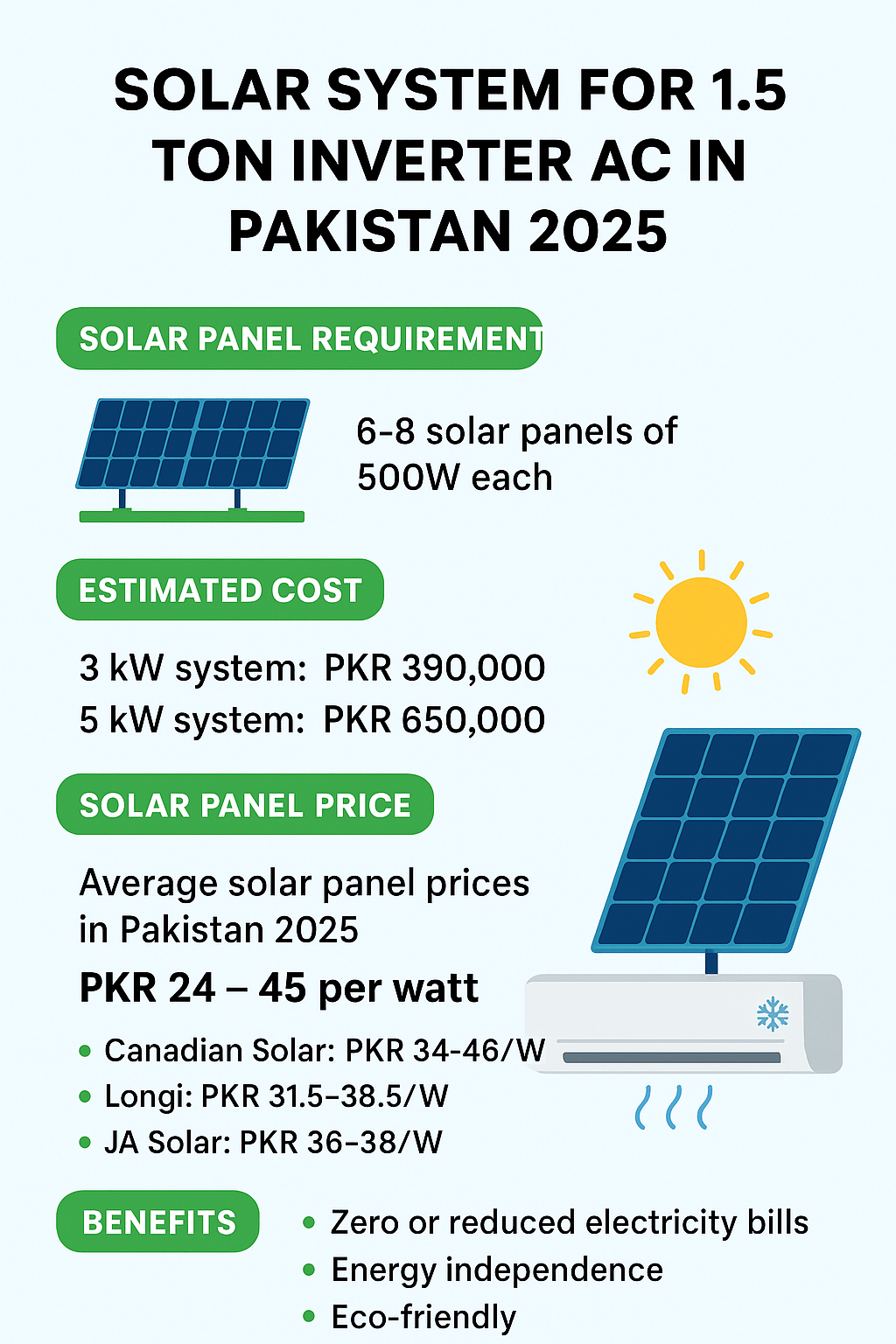
✅ So, to run a 1.5 ton inverter AC comfortably, you’ll need around 6 to 8 high-quality solar panels (500W each), depending on your usage and backup requirements.
Solar Panel System Price in Pakistan for 1.5 Ton AC (2025 Update)
As we step into 2025, the demand for solar panels in Pakistan is at an all-time high. With electricity tariffs skyrocketing and summer heat becoming unbearable, more households are turning towards solar systems to run their 1.5 ton inverter ACs without worrying about heavy electricity bills. Here’s a complete breakdown of the costs.
Average Solar Panel Price in Pakistan (2025)
-
Per-watt cost range: Quality solar panels are priced between PKR 24 to PKR 45 per watt, depending on brand and technology.
-
Brand examples: Canadian Solar panels usually fall between PKR 34–46/W, Longi panels range around PKR 31.5–38.5/W, and JA Solar panels average PKR 36–38/W.
Estimated Cost: 3 kW Solar System (Ideal for 1.5 Ton AC)
A 3 kW solar system is the most suitable option to power a 1.5 ton inverter AC along with basic household loads.
-
Market price (complete with inverter and installation): Around PKR 390,000.
Cost Breakdown Example:
| Component | Estimated Cost (PKR) |
|---|---|
| Solar Panels (3 kW × PKR 35/W) | ~ PKR 105,000 |
| Inverter + Installation | ~ PKR 285,000 |
| Total System Cost | PKR 390,000 |
(Note: Final figures depend on panel brand, inverter type, and installer charges.)
Estimated Cost: 5 kW Solar System (For AC + Other Appliances)
If you want to power more than just the AC—like fans, lights, fridge, and even a water pump—then a 5 kW solar system is a better choice.
-
Average cost range: Between PKR 650,000 to 800,000, depending on brand, inverter type, and installation.
Example Packages by Top Brands
Here’s what you can expect from trusted solar panel brands in Pakistan:
-
Canadian Solar: PKR 34–46/W
-
Longi: PKR 31.5–38.5/W
-
JA Solar: PKR 36–38/W
Why This Investment Makes Sense
Switching to solar isn’t just about savings—it’s about energy independence, reliable cooling, and a smart long-term investment. With rising tariffs and load-shedding, a 3 kW solar system for your 1.5 ton AC can pay back in just 2–4 years through reduced bills and net metering benefits.
In short:
-
A 3 kW system (~PKR 390,000) is perfect for running a 1.5 ton AC.
-
A 5 kW system (PKR 650,000–800,000) supports your AC plus other major appliances.
-
Choosing trusted brands like Canadian Solar, Longi, or JA Solar ensures efficiency and long-lasting performance in Pakistan’s climate.
Best Inverters for Running 1.5 Ton AC on Solar
When it comes to running a 1.5 ton inverter AC on solar panels, the inverter you choose is just as important as the solar panels themselves. A reliable inverter ensures smooth performance, better energy conversion, and the ability to handle heavy appliances like an air conditioner without tripping or overloading.
Recommended Solar Inverter Brands in Pakistan
Several solar inverter brands in Pakistan have proven to be highly reliable for running ACs. Here are some of the top picks:
-
Inverex – One of the most popular names in Pakistan’s solar market. Known for durability, hybrid options, and strong after-sales service.
-
Tesla – Affordable yet efficient, Tesla inverters are a good choice for budget-conscious households.
-
Fronus – Offers reliable hybrid inverters with good load management for both residential and commercial setups.
-
Sungrow – A premium international brand recognized for high efficiency, advanced MPPT technology, and long lifespan.
These brands are widely available in Pakistan and work well with solar systems designed for AC loads.
Hybrid vs Off-Grid Inverters for AC
When selecting an inverter for your 1.5 ton AC, you’ll usually choose between hybrid and off-grid systems:
-
Hybrid Inverters:
-
Can use solar power, batteries, and the grid together.
-
Ideal for areas with frequent load-shedding.
-
Allow net metering, so you can sell excess electricity back to the grid.
-
Best option if you want uninterrupted cooling without relying solely on one power source.
-
-
Off-Grid Inverters:
-
Work only with solar panels and batteries (no grid connection).
-
Suitable for remote areas with no access to WAPDA.
-
Require a bigger battery bank to keep the AC running at night.
-
For most households in Pakistan, hybrid inverters are the better choice, as they provide flexibility and long-term savings.
Importance of MPPT Technology & Load Handling
When buying an inverter for your 1.5 ton solar AC, make sure it has MPPT (Maximum Power Point Tracking) technology. MPPT ensures maximum energy conversion from solar panels, giving you higher efficiency, especially during variable sunlight conditions.
Also, check the load handling capacity of the inverter. For running a 1.5 ton inverter AC smoothly, you’ll need at least a 3 kW inverter, but going for a 5 kW hybrid inverter is often recommended if you plan to run additional appliances like fans, lights, and refrigerators.
Battery Requirement for 1.5 Ton AC on Solar
When planning to run a 1.5 ton inverter AC on solar panels, one of the biggest questions is: “Do I need batteries, or can my AC run without them?” The answer depends on whether you’re going for an on-grid, hybrid, or off-grid solar system. Let’s break it down in simple terms.
Can You Run AC Without Battery? (On-Grid Solution)
Yes, you can! If you install an on-grid solar system, your 1.5 ton AC can run directly on solar power during the day without needing batteries. In this setup, the AC uses electricity produced by your panels, and any extra power can be sent back to the grid through net metering.
This option is more cost-effective because you save on the high price of batteries. However, the downside is that during load-shedding or at night, your AC won’t run unless you have grid supply.
When is Battery Backup Necessary?
A battery backup becomes important in the following cases:
-
You live in an area with frequent load-shedding and need the AC to run even when the grid is down.
-
You want your AC to work at night using stored solar energy.
-
You’re setting up an off-grid system (no connection to WAPDA).
In such cases, a hybrid or off-grid inverter with batteries is the best choice to ensure uninterrupted cooling.
Cost of Batteries in Pakistan (2025)
The cost of batteries in Pakistan varies depending on type and capacity:
-
Lead-Acid Batteries:
-
Widely available, lower upfront cost.
-
Shorter lifespan (2–3 years).
-
Price range: PKR 40,000 – 90,000 per battery (150Ah–250Ah).
-
-
Lithium-Ion Batteries:
-
Expensive but highly efficient and long-lasting (8–10 years).
-
Faster charging and deeper discharge capacity.
-
Price range: PKR 150,000 – 350,000 depending on capacity (2.5kWh–5kWh).
-
For running a 1.5 ton inverter AC for several hours during load-shedding, you’ll typically need at least a 4–5 kWh lithium battery bank or a set of high-capacity lead-acid batteries.
Net Metering Benefits for Running AC on Solar
One of the biggest advantages of installing a solar system for your 1.5 ton AC in Pakistan is the option of net metering. With electricity bills going higher every month, net metering gives homeowners the chance to not only save money but also earn from their solar investment. Let’s explore how it works and why it’s such a game-changer.
How Net Metering in Pakistan Reduces Bills
Net metering is a government-approved system that allows you to connect your solar panels to the WAPDA grid. During the day, when your solar panels generate electricity, they first power your inverter AC and home appliances. If there’s extra energy left, it is sent back to the grid, and your meter records the units you’ve exported.
At the end of the billing cycle, your exported units are subtracted from the imported ones. This directly reduces your electricity bill—sometimes even bringing it down to zero in summer months when your solar system produces more than you consume.
Selling Excess Solar Electricity Back to the Grid
The beauty of net metering is that it transforms your home into a mini power station. On cooler days, when your 1.5 ton AC is not running as much, your solar panels may generate more power than your home needs. Instead of wasting this energy, you sell it back to the grid and earn credits.
This means your solar system works for you all year round, not just when your AC is on. In simple words: the more sunlight you get, the more savings you enjoy.
Payback Period for Solar Investment
Many people hesitate to invest in solar because of the upfront cost. But here’s the reality: with net metering, most households in Pakistan recover their investment in just 3 to 5 years.
For example:
-
A 3kW solar system (ideal for a 1.5 ton AC) costs around PKR 380,000–400,000.
-
By reducing your monthly electricity bill to near zero and exporting extra units, you can save PKR 8,000–15,000 per month, depending on your usage.
-
These savings quickly add up, covering the system cost within a few years. After that, it’s pure profit and free electricity for 20+ years!
Pros & Cons of Running a 1.5 Ton Inverter AC on Solar
Like every big investment, running your 1.5 ton inverter AC on solar panels comes with its own set of advantages and challenges. For most Pakistani households, the benefits far outweigh the drawbacks—but it’s important to look at both sides before making a decision.
✅ Benefits of Running a 1.5 Ton AC on Solar
-
Zero or Reduced Electricity Bills
The biggest benefit is financial relief. A properly sized solar system can run your AC during hot summer days without adding pressure on your WAPDA bill. In many cases, households even bring their monthly bill down to zero with net metering. -
Energy Independence
Tired of load-shedding ruining your comfort? A hybrid solar system with battery backup lets you enjoy uninterrupted cooling, even during power outages. No more sleepless summer nights without AC! -
Eco-Friendly Cooling
Solar energy is a clean and renewable source. By running your AC on solar, you’re reducing your carbon footprint and contributing to a greener Pakistan. -
Long-Term Savings
While the upfront cost feels heavy, the system quickly pays for itself within 3–5 years. After that, you’re essentially enjoying free electricity for the next 20+ years.
❌ Challenges of Running a 1.5 Ton AC on Solar
-
High Upfront Cost
Setting up a 3kW–5kW solar system to run a 1.5 ton AC can cost anywhere between PKR 390,000 to 800,000, depending on whether you choose on-grid, hybrid, or off-grid solutions. For many families, this initial investment is the biggest hurdle. -
Battery Maintenance (If Used)
If you opt for batteries to run your AC at night or during load-shedding, be prepared for extra costs. Lead-acid batteries require regular maintenance and need replacement every 2–3 years. Lithium-ion batteries last longer but are much more expensive. -
Space Requirement
To power an AC, you’ll need around 6–8 solar panels (500W each), which requires sufficient rooftop space. Not every household has the ideal setup.
Factors Affecting Solar System Cost in Pakistan
If you’re planning to shift your 1.5 ton inverter AC to solar, one of the first questions that comes to mind is: “How much will it cost me?”
The truth is, the price of a solar system in Pakistan isn’t fixed—it depends on a few important factors. Let’s break them down in simple terms.
1. Solar Panel Brand & Quality
Not all solar panels are created equal. Popular international brands like JA Solar, Longi, Canadian Solar, and Trina Solar are known for their higher efficiency and longer lifespan. While cheaper, local or low-quality panels may save you money initially, they often generate less electricity and wear out faster. Investing in a trusted brand ensures better performance and durability.
2. System Size (3kW vs 5kW)
The size of your solar system directly impacts the price.
-
A 3kW system is usually enough to run a 1.5 ton AC comfortably during the day.
-
A 5kW system not only covers your AC but also powers additional home appliances like fans, fridge, and lights.
Bigger systems cost more but provide greater savings in the long run.
3. Type of Inverter (Hybrid, Off-Grid, On-Grid)
Your choice of inverter plays a huge role in the total cost.
-
On-Grid Inverter → Cheapest option, works with net metering, but doesn’t provide backup during load-shedding.
-
Off-Grid Inverter → Works independently with batteries, but requires higher investment and battery maintenance.
-
Hybrid Inverter → Best of both worlds. It connects with the grid, supports batteries, and ensures backup during outages. Slightly more expensive but ideal for Pakistani households facing load-shedding.
4. Installation & Warranty Services
A solar system is a long-term investment (20–25 years). That’s why proper installation, after-sales service, and warranty matter just as much as the panels themselves. Always choose an installer who provides guaranteed warranty, quality workmanship, and net metering assistance.
FAQs
Q1: How many solar panels are required for a 1.5 ton AC?
On average, a 1.5 ton inverter AC requires around 6–8 solar panels of 500W each to run smoothly. The exact number may vary depending on factors like panel efficiency, type of inverter, and whether you also want to power other appliances such as lights, fans, or a fridge alongside your AC.
Q2: Can a 3kW system run a 1.5 ton inverter AC?
Yes ✅, a 3kW solar system is typically enough to run a 1.5 ton inverter AC during daytime. However, if you plan to run additional appliances like fans, lights, or a refrigerator, upgrading to a 5kW system is a smarter choice for long-term efficiency.
Q3: What is the cost of running AC on solar panels in Pakistan 2025?
In 2025, the average cost of running a 1.5 ton AC on solar is:
-
3kW system → PKR 390,000 – 480,000
-
5kW system → PKR 650,000 – 780,000
This price usually covers solar panels, inverter, and installation. The final cost depends on your chosen brand (JA Solar, Longi, Canadian Solar, Trina Solar) and system type (on-grid, hybrid, or off-grid).
Q4: Which solar inverter is best for AC in Pakistan?
For running AC on solar, you need an inverter with MPPT technology and strong load-handling capacity. Popular and reliable inverter brands in Pakistan include Inverex, Fronus, Tesla, and Sungrow. Among these, hybrid inverters are considered the best because they allow you to use solar power, grid electricity, and batteries together.
Q5: Do I need batteries for AC on solar?
Not always. If you are using an on-grid system, your AC can run directly on solar during the day without batteries. However, if you want to run your AC at night or during load-shedding, you’ll need lithium-ion or lead-acid batteries for backup power.
Q6: How much does a 3kW solar system cost in Pakistan (2025)?
A 3kW solar system in Pakistan costs between PKR 390,000 – 480,000 in 2025. This makes it the most common choice for homeowners looking to power a 1.5 ton inverter AC.
Q7: What is the lifespan of solar panels in Pakistan?
High-quality solar panels generally last 20–25 years, depending on proper care and maintenance. On the other hand, solar inverters usually last 8–10 years, after which they may need replacement.
Q8: Which inverter is best for running AC on solar in Pakistan?
Trusted inverter options for AC usage in Pakistan include Inverex, Tesla, Fronus, and Sungrow. If you want maximum flexibility and reliability, a hybrid inverter is the best investment, as it works seamlessly with solar, batteries, and grid power.
Conclusion – Is Solar the Right Choice for Your 1.5 Ton Inverter AC?
Switching your 1.5 ton inverter AC to solar panels in Pakistan is not just about comfort during scorching summers—it’s about cutting down electricity bills, achieving energy independence, and making a smart long-term investment.
Yes, the initial cost of a 3kW to 5kW solar system may seem high, but when you factor in zero monthly bills, net metering benefits, and 20+ years of free electricity, the system quickly pays for itself. Add to that the peace of mind during load-shedding, and solar becomes a truly future-proof solution.
In simple words:
✅ You enjoy cool summers without worrying about bills
✅ You protect yourself from ever-rising electricity prices
✅ You contribute to a greener, eco-friendly Pakistan
If you’re serious about reducing your dependency on the grid and enjoying hassle-free AC usage on solar, now is the best time to invest.